Harford County Health Department inspects restaurants and other food service facilities to routinely monitor food handling practices, and sanitary and physical conditions. Depending on the type of food service offered by the facility, routine random inspections are conducted up to three times a year. Complaints, non-compliance re-inspections, and foodborne illness outbreak investigations prompt additional inspections.
Licensed Environmental Health Specialists (LEHS) closely evaluate eleven critical food safety items which most often contribute to foodborne illness. Critical items are food safety requirements which must be followed to reduce the incidence of food-related illness and injury. If a critical food safety violation is discovered, it must be corrected immediately or the facility is closed until the violation is corrected. The Critical Violations and their code # are shown below in the Critical Violations – Inspection Report Key.
In addition to the below Critical Items, LEHS’s also evaluate food service facilities for general food handling and facility maintenance, or Good Retail Practices (GRPs). GRP’s are preventive measures to control the introduction of pathogens, chemicals, and physical objects into foods. Facilities found in violation of GRP’s are not routinely closed. Instead, compliance within 30 days, or within a time frame specified in a written compliance schedule, is required.
Critical Violations – Inspection Report Key
| Observation | Code | Description | COMAR Example | ||
| 1. Food obtained from an approved source | 1 | Food comes from a safe, approved source. (Ex. Facilities inspected and licensed by FDA, USDA, and Local Health Departments etc.) | Meat purchased from a licensed supplier; shellfish purchased from a certified dealer; food is not prepared in an unapproved home kitchen. | ||
|
2. Food separated and protected from adulteration, spoilage, and contamination
|
2 | Food is protected from contamination, spoilage, and unsafe conditions. | Raw chicken stored must below ready-to-eat food; food must be covered in the refrigerator; spoiled or contaminated food discarded. | ||
|
3. Food workers with infection or diarrhea restricted in accordance with COMAR 10.06.01
|
3 | Sick food employees are restricted from food preparation areas. | An employee with diarrhea shall not prepare or serve food; an employee with certain diagnosed illnesses is excluded or restricted as required. | ||
| 4. Hands clean and properly washed | 4 | Employees wash their hands correctly and at the right times. |
Washing hands before handling food and after using the restroom, touching the face/body, handling raw meat, taking out trash, or other activities that can contaminate hands.
|
||
| 5. Cooling time and temperature | 5 | Cooked food is cooled appropriately and kept at safe temperatures while cooling. |
Chili is divided into shallow pans or otherwise cooled properly instead of being left in a large, deep container to cool slowly. |
||
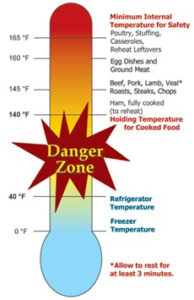
| 6a. Cold holding temperature | 6a | Cold food is maintained at 41°F or below. |
Cut tomatoes, cooked chicken, deli meats, milk, and other TCS foods are held at 41°F or colder.
|
||
| 6b. Hot holding temperature | 6b | Hot food is maintained at the required hot-holding temperature. |
Soup on a steam table is maintained at the required hot-holding temperature instead of sitting at room temperature.
|
||
| 7a. Cooking time and temperature | 7a | Food is cooked to the required temperature for the required time. |
Chicken is cooked to the required temperature; ground beef is cooked to its required temperature; foods are checked with a calibrated thermometer.
|
||
| 7b. Reheating time and temperature | 7b | Previously cooked food is reheated quickly to the required temperature before hot holding. |
Refrigerated chili is rapidly reheated on the stove before being placed on the steam table; a steam table is not used to slowly reheat cold food.
|
||
| 8. Potable hot and cold running water provided | 8 | Safe hot and cold running water is available where required. |
Handwashing sinks shall have hot and cold potable water. Water is available for food preparation, cleaning, and other required uses. Hot water is defined as water achieving 100°F or greater.
|
||
| 9. Sewage discharged in accordance with all applicable State and local codes | 9 | Sewage and wastewater are disposed of properly. | Wastewater goes into an approved wastewater system; sewage shall not be discharged onto the ground or into a storm drain. |
In an effort to promote transparency, our office is posting reports of Food Service Facility (FSF) inspections performed each month. As of September 2026, these reports will provide the FSF and address, the date and type of inspection performed and a list of critical violations noted if applicable. You will also see if a Follow up Inspection was required for that facility. As of October 2026, there will be a score provided on the report. The SCORE represents the uncorrected violations at the time of the dated inspection. The score is based on a 100% score set. Scores less than 85% warrant a reinspection after 30-days.
To obtain copies of Food Service Facility Inspection Reports, complete the Public Information Act (PIA) request form and return to our office via the email on this PIA form.