Top Things to Know About Septic Systems
Many homes and businesses rely on septic systems to treat wastewater. Understanding the significant value they provide and how they work can help system owners protect their investment. Here are the top four things you should know about septic systems and how to keep them working effectively.
A properly designed, installed, and maintained onsite wastewater treatment (septic) system can be an effective tool in treating wastewater for homes and businesses.
- Wastewater treatment involves the reduction of nutrients, organics and pathogenic bacteria, thereby reducing environmental impact and protecting human health. A system is comprised of two major components – a septic tank and the soil dispersal area or drainfield.
- Maryland’s Bay Restoration Fund supports replacement of conventional septic tanks to Best Available Technology (BAT) for enhanced nitrogen removal (55-77%) compared to 5-6% for a septic tank. Drainfields can reduce an additional 25-40% of nitrogen depending on design, and the quality and depth of soil. The effectiveness of wastewater treatment also depends on proper maintenance of a septic system.
Septic systems are unique and designed specifically based on local site conditions.
- Septic system designers consider several critical factors when planning a treatment system:
- Site soil quality (texture, structure, depth to a limiting layer such as water table, and water percolation capacity)
- Number of bedrooms or size of business wastewater strength (home, school, office, or food service business)
- Wastewater strength (home, school, office, or food service business)
Soil plays a critical role in wastewater treatment. Consequently, an extensive soil evaluation is necessary to identify soil characteristics (quality, depth), water percolation rate, depth to groundwater, and various landscape features. This information guides designers or engineers in developing a system plan that will treat the specified wastewater quality and quantity. A home expansion or business change can result in increased wastewater flow or strength into the system. A designer may need to reconfigure the system to ensure it can handle the increased treatment demands.
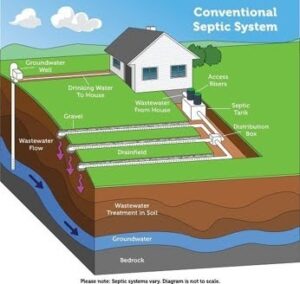
A conventional septic system includes a tank for settling solids and storage, and the soil dispersal area or drainfield to treat wastewater before it infiltrates to groundwater (https://www.epa.gov/septic/types-septic-systems#conventional).
Not all properties are suitable for a septic system, and some sites do not allow for drainfield replacement.
- Some sites have soils and other limiting factors that will not allow for adequate wastewater treatment, and therefore prevent installation of a septic system. In addition, some sites with a failing drainfield may not have adequate space or soil quality for replacement of the drainfield. In these cases, a holding tank or connection to sewer may be the only treatment option. Developed communities with septic system issues may want to explore an option of extension of nearby public sewer infrastructure, or the feasibility of a cluster community system with individual home septic tanks and a community drainfield, to address future needed repairs.
Knowing about your septic system and how to care for it can save money and reduce costly repairs.
- Homeowners should become familiar with their system type and location and follow recommended maintenance practices. The local county health department may have a record on the system including its type and location. Homeowners can protect the system and prolong its life by guarding the area from traffic, excessive stormwater, and improper landscaping/planting. Like any mechanical device or system, septic systems have a lifespan. Tanks may last many decades, and soil dispersal areas or drainfields may last 25-40 years. However, eventually the soil pores will become clogged with organic material and bacterial films. Once this occurs, the drainfield needs to be replaced in a new location with undisturbed soil. Newer homes have a dedicated repair area for drainfield replacement. Additional practices to care for a system and prolong its life include:
- Pumping the tank every 3-5 years at a minimum
- Flushing only toilet paper
- Not disposing excess cleaners or chemicals
- Maintaining the service contract on an advanced treatment system or BAT unit.
Septic System Resources
EPA Septic Systems: https://www.epa.gov/septic
Maryland Onsite Wastewater Professional Association (MOWPA): https://www.mowpa.org/MOWPA/
Maryland Department of Environment – Onsite Systems: https://mde.state.md.us/ programs/water/bayrestorationfund/onsi tedisposalsystems/pages/onsitesystems.aspx
National Onsite Wastewater Recycling Association: https://www.nowra.org
University of Maryland Extension – Water Quality/Well and Septic Education Program: http://extension.umd.edu/well-and-septic; and UME Water Quality
YouTube Channel: https://www.youtube.com/channel/UCvfJKDDg069yBHRZzhg wiLQ